You cannot protect what you cannot see
Business teams can adopt applications and connect data before security establishes ownership, policy, or monitoring.
Ashva continuously brings SaaS applications, risky settings, identities, permissions, threat context, and compliance evidence into one prioritized operating view.
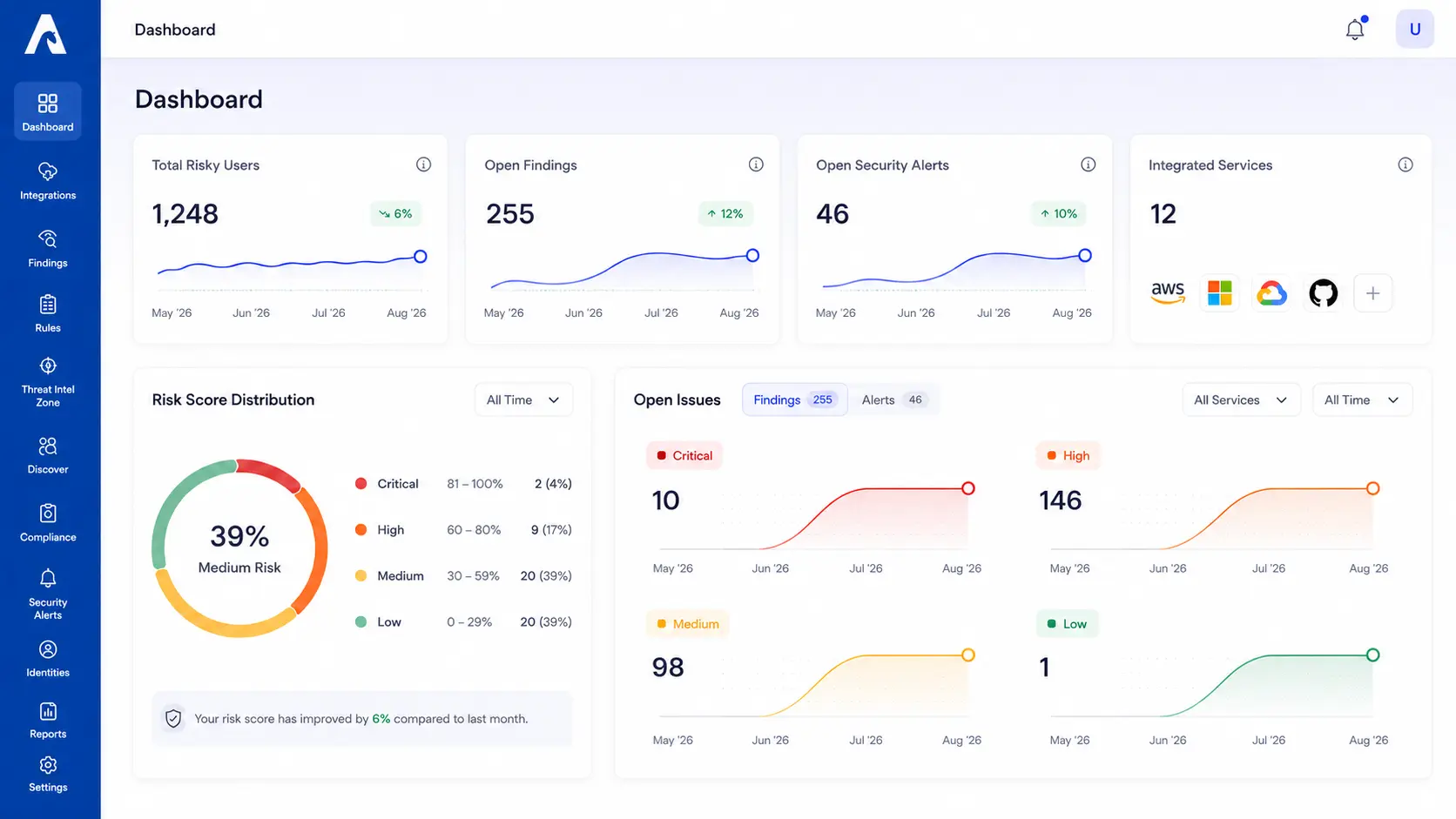
SaaS changes constantly. New applications, users, permissions, and integrations create security gaps that periodic reviews struggle to catch.
Business teams can adopt applications and connect data before security establishes ownership, policy, or monitoring.
A single sharing rule, administrator role, integration scope, or inactive account can leave sensitive SaaS data accessible.
Point-in-time spreadsheets cannot keep pace with changing identities, permissions, configurations, and threat conditions.
Ashva unifies SaaS security insights and workflows to turn fragmented findings into coordinated risk reduction.

Build visibility, reduce exposure, improve access hygiene, and create a repeatable SaaS security operating model.
Find unapproved and unmanaged SaaS use before it becomes an invisible attack path.
Explore feature →Continuously identify weak SaaS configurations and turn findings into practical remediation work.
Explore feature →Turn meaningful SaaS activity into focused alerts your team can investigate quickly.
Explore feature →Understand users, service accounts, privileges, and access across your connected SaaS estate.
Explore feature →Find users and applications with more access than their role or activity requires.
Explore feature →Identify inactive accounts that still retain access to business-critical SaaS data.
Explore feature →Map SaaS security controls and evidence to the frameworks your organization follows.
Explore feature →Connect SaaS posture findings with relevant threat signals to focus attention where it matters.
Explore feature →Monitor for exposed credentials and organization-linked signals that may affect SaaS access.
Explore feature →Continuously watch connected SaaS applications for risky changes, new exposure, and control drift.
Explore feature →Continuously review access, roles, groups, and app permissions across SaaS environments.
Explore feature →Route, assign, enrich, and track SaaS security work through repeatable automated workflows.
Explore feature →Start with a focused scope, then expand coverage as your security program matures.
Add approved SaaS applications and discovery sources using appropriate access.
Normalize posture, identity, access, activity, and compliance signals.
Focus teams on findings with meaningful exposure and business context.
Route ownership, track fixes, collect evidence, and verify change.
Give each stakeholder the view, context, and workflow needed to make better security decisions.
Gain a defensible view of SaaS exposure, priorities, ownership, and progress without adding another disconnected security console.
Explore solutionUnify posture, identity, activity, and threat signals so analysts can focus on issues with meaningful business impact.
Explore solutionSee application ownership, user access, permissions, and configuration drift across the tools your teams rely on.
Explore solutionMap findings and evidence to relevant control areas while maintaining a clear record of ownership and remediation.
Explore solutionExplore supported and configurable connections across identity, collaboration, CRM, cloud, ticketing, and business SaaS.
 NotionCollaboration applications
 1PasswordIdentity and access
 AsanaProject management
 BoxCloud storage
 CiscoNetwork and security
 DocuSignBusiness SaaS
 Duo PremierIdentity providers
 GitHubDeveloper tools
 GitLabDeveloper tools
 JiraTicketing systems
 LucidchartCollaboration applications
 Microsoft Entra IDIdentity providers
 MongoDB AtlasCloud services
 OktaIdentity providers
 OneLoginIdentity providers
 SalesforceCRM platforms
 SendGridEmail services
 SlackCollaboration applications
 SnowflakeCloud services
 ZendeskTicketing systems
 ZoomCollaboration applications
 Bitbucket CloudDeveloper tools
 Google WorkspaceCollaboration applications
 ChatGPTAI applications
 CursorAI developer tools
 OpenAIAI applications
 ClaudeAI applications
 SmartsheetProject management
 Microsoft Power BIAnalytics platforms
 AtlassianBusiness SaaS
 Microsoft Power AppsLow-code platforms
 FastlyCloud services
 DatabricksData platforms
 DatadogMonitoring and observability
 Ping IdentityIdentity providers
 ZohoBusiness SaaS
 DropboxCloud storage
 TrelloProject management
 MiroCollaboration applications
Ashva supports compliance readiness by helping map relevant SaaS findings, evidence, ownership, and remediation. It does not certify or guarantee compliance.

Map SaaS safeguards, risk treatment evidence, and control ownership to relevant information security control areas.

Organize technical evidence and remediation activity that can support Security and other applicable Trust Services Criteria.

Surface SaaS access, sharing, identity, and configuration signals relevant to protecting personal data.

Support reviews of SaaS access and safeguards for systems that may handle protected health information.
Track SaaS access and control evidence relevant to systems connected to cardholder-data workflows.
Align SaaS visibility, protection, detection, and response work to relevant NIST control and outcome areas.
Connect SaaS inventory, access control, secure configuration, logging, and remediation evidence to CIS safeguards.
Choose a focused starting point or an enterprise-wide program. Final pricing reflects application scope, identity volume, and workflow requirements.
For teams beginning with their highest-risk SaaS applications.
For growing organizations coordinating SaaS security across teams.
For complex SaaS stack, multiple business units, or service providers.
Seven practical answers for teams evaluating SaaS security posture management.
SaaS Security Posture Management, or SSPM, continuously discovers and assesses security settings, identities, permissions, integrations, and activity across SaaS applications. It helps teams find risk, prioritize remediation, and monitor posture as SaaS environments change.
SSPM focuses on the security posture inside SaaS applications: configurations, identities, permissions, integrations, and control drift. CASB commonly focuses on policy enforcement and data protection between users and cloud services. Many organizations use them together.
Ashva can correlate approved discovery sources and identity or access signals to identify SaaS applications that may not be centrally managed. Available discovery methods depend on the data sources and permissions connected by your organization.
Ashva supports a growing catalog across business SaaS, identity, collaboration, CRM, cloud, ticketing, and security platforms. The integrations page lists the currently presented catalog; additional applications can be discussed with the Ashva team.
Timing depends on the number of applications, access approvals, and desired workflows. A focused initial rollout can begin quickly, followed by phased onboarding for additional applications and teams.
Yes. Ashva can help map SaaS controls, findings, evidence, ownership, and remediation to frameworks such as ISO 27001, SOC 2, GDPR, HIPAA, PCI DSS, NIST, and CIS Controls. It supports compliance readiness but does not certify or guarantee compliance.
Ashva provides a consolidated view of users, administrators, guests, service accounts, roles, entitlements, and activity. It helps teams identify dormant access, excessive permissions, and ownership gaps for review and remediation.
See how Ashva can help your team discover SaaS risk, prioritize what matters, and coordinate remediation across your existing tools.